
Field Notes from CES: Accessibility Starts With Listening
By Tara Newell, Executive Director, Project S.E.R.V.E.
At CES, it’s easy to be swept up in what’s new, fast, and flashy.
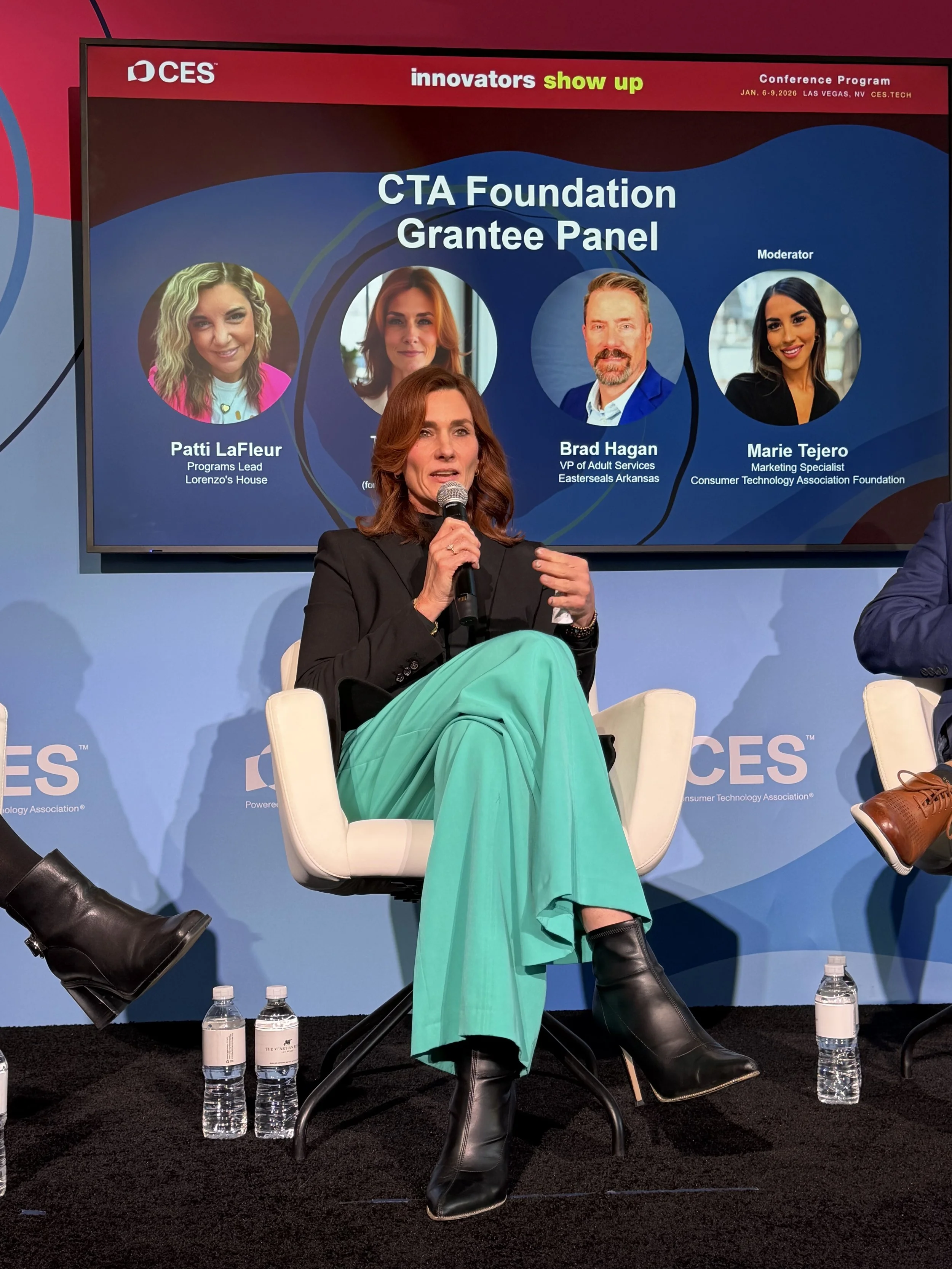
But sitting on the CTA Foundation Grantee Panel (watch it here) with Brad Hagan of Easterseals Arkansas and Patti LaFleur, M. ED, CDP of Lorenzo's House, I was reminded of something much simpler—and far more important:
Accessibility doesn’t start with technology. It starts with listening.
At Project S.E.R.V.E., we don’t define accessibility for the people we serve. We don’t come in with assumptions. Every veteran and emergency responder who applies to our program brings a completely unique challenge, shaped by their body, their lifestyle, and their lived experience.
They define what accessibility means.
If a solution works for them, then it’s accessible. That’s it.
Designing With, Not For
One of the questions we discussed on the panel was how organizations approach problem-solving in accessibility. Our answer is always the same: We don’t go looking for problems to solve. Our participants come to us.
From the very beginning, veterans and emergency responders are involved in defining the challenge. They don’t just hand it off to student engineers—they guide the entire process.
They’re in regular meetings. They test prototypes. They give feedback early and often.
They are essential partners in the design process. We simply can’t do this work without them. That’s how we make sure solutions are practical, personal, and actually used in daily life.
What Success Really Looks Like
For us, success isn’t abstract. It looks like:
A solution that works in the real world
A veteran or responder who feels seen, heard, and supported
A student who understands—often for the first time—what it means to design with real human stakes
Our students are busy. They’re balancing classes, jobs, and everything else college life brings. But when they know a real person is waiting on the other end of their work—someone whose independence or quality of life depends on it—they stay in the lab longer. They care more deeply.
And that sense of fulfillment–that’s success.
Growing Through Collaboration
Thanks to the support of the CTA Foundation, Project S.E.R.V.E. has grown in meaningful ways. We now partner with 27 universities nationwide, and we’re entering the third year of our National Design Competition.
This year’s challenge focuses on a warming sleeve for para-athletes competing in winter sports at national and international levels—an example of how specialized, user-driven design can make a real difference.
None of this happens in isolation.
Collaboration is everything. Platforms like CES matter not because of the spotlight, but because they connect people who want to help, build, and contribute together. And as much as “what happens in Vegas stays in Vegas,” this is one thing I don’t want staying there.
These stories matter. This work matters. And we need more people to know what’s possible when we listen first.
Why This Work Is Personal
I spent 25 years as a military spouse. My oldest son now serves on active duty in the Air Force. Service isn’t just something I admire—it’s part of my family’s legacy. When I see veterans and emergency responders regain confidence and hope, and when I see students discover purpose through engineering, that double impact keeps me going.
That—and, admittedly, the ping pong robot at CES that nearly convinced me I need a new hobby.
