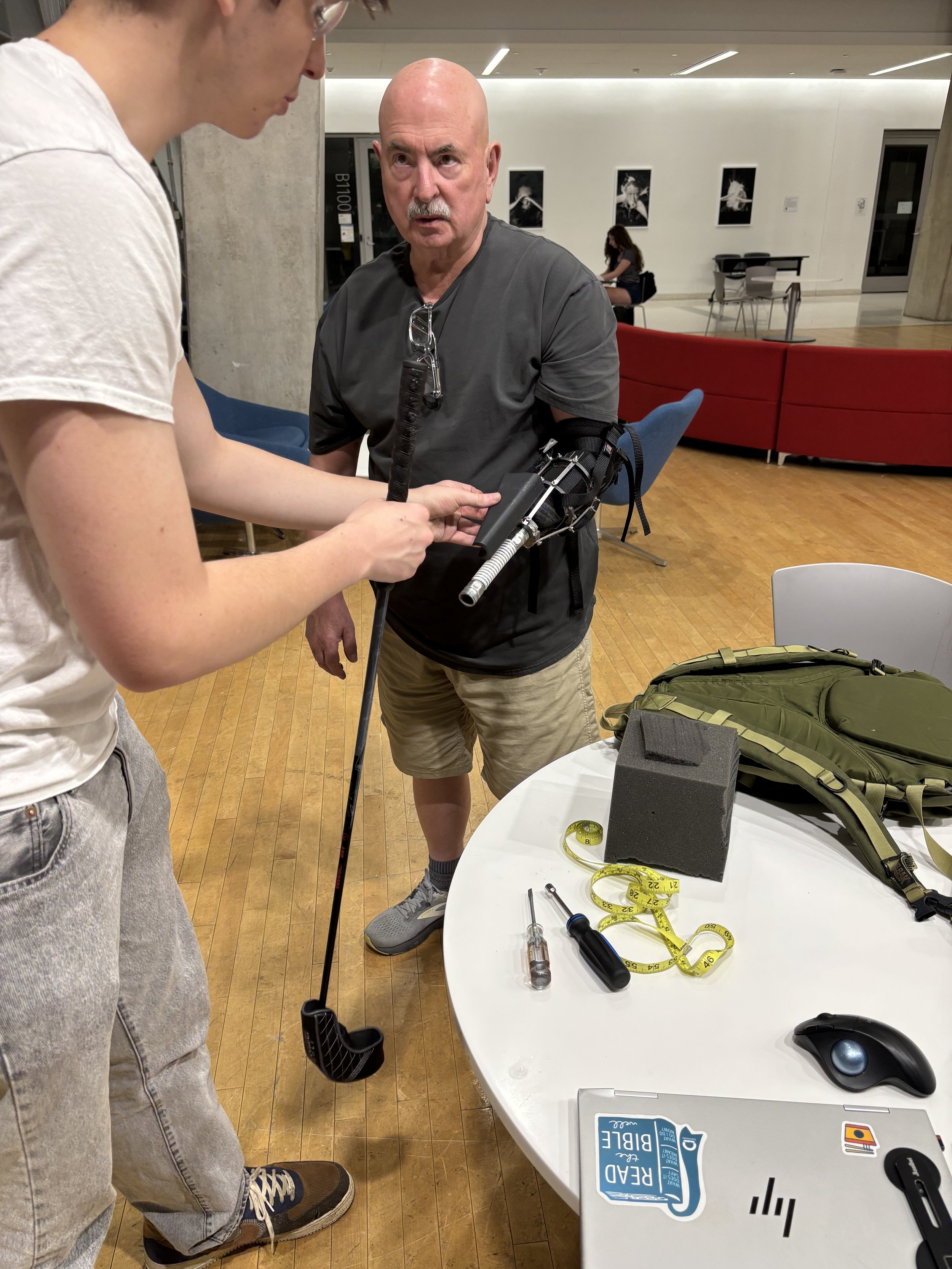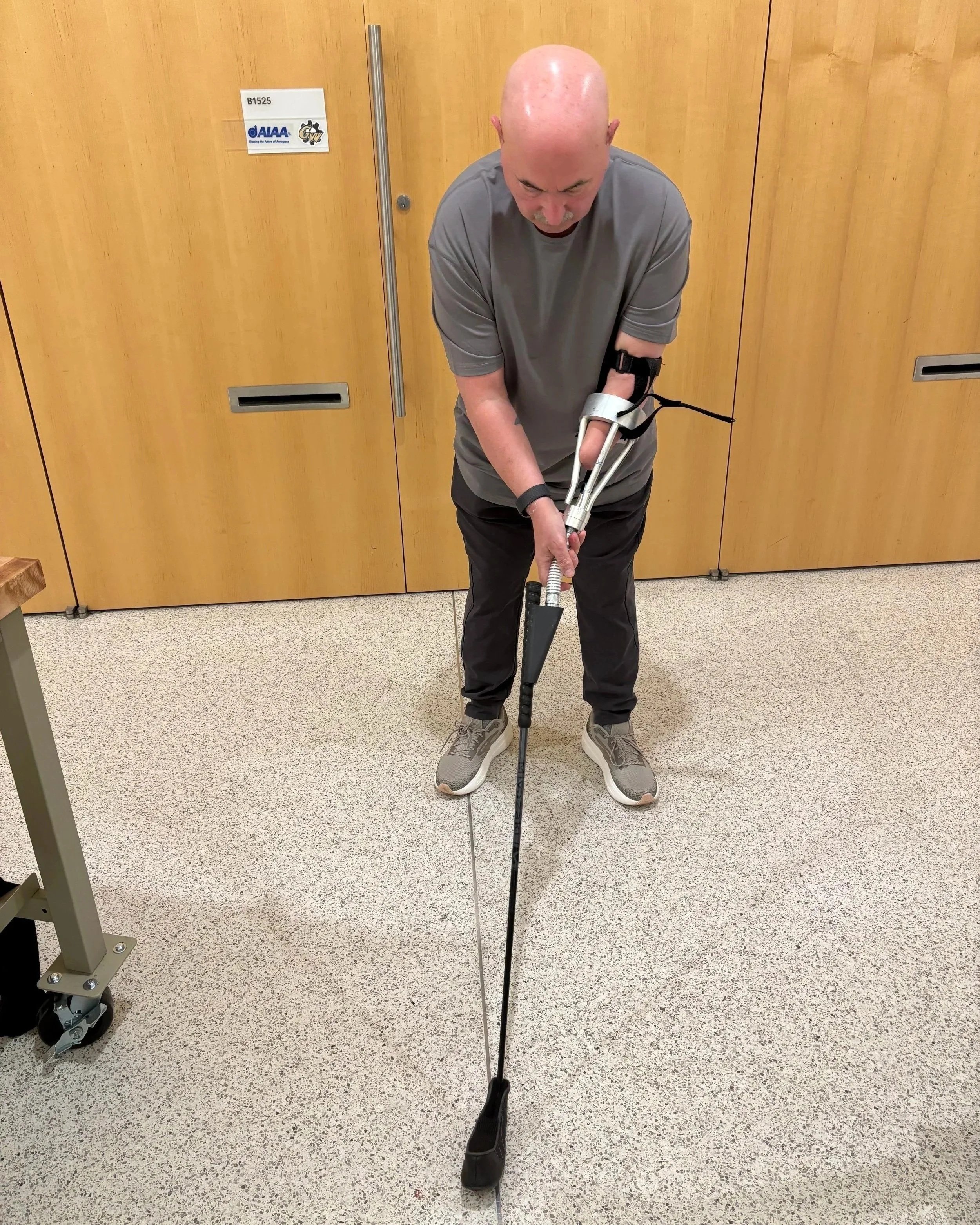
Col Paul Sturm, US Army
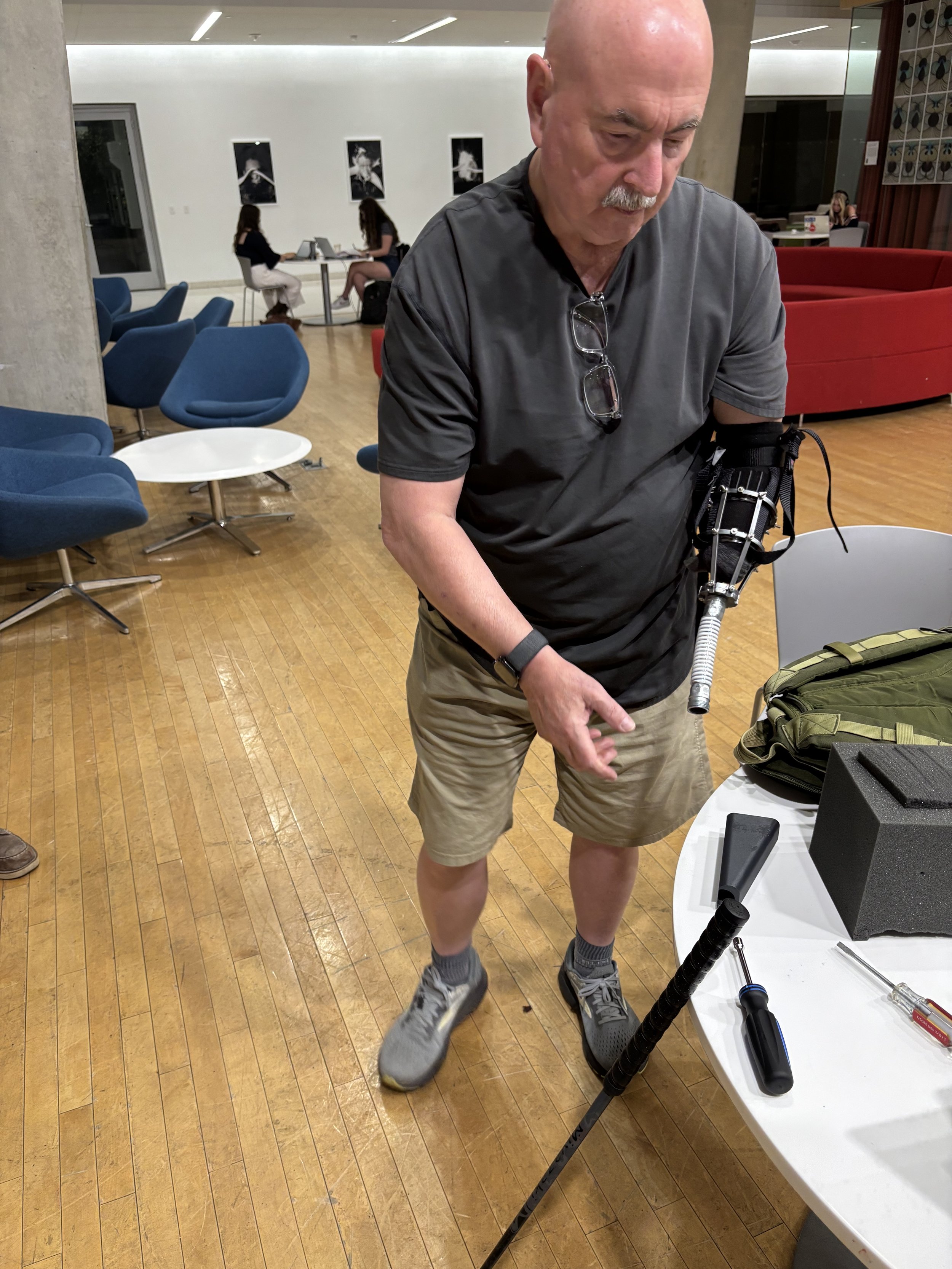
For a while, golf wasn’t really an option for U.S Army Colonel, Paul Sturm. Not in the way most people think of it. He lost most of his left hand in a firing range accident in 1980. What followed wasn’t a dramatic reinvention of his life, at least not in the way you might expect.
“It was a matter of full acceptance and adaptation,” he shared. “My right arm just got stronger.” That mindset carried him through the rest of his life but, when it came to golf, something as precise and dependent on full-body coordination as a swing, adaptation had its limits.
“I never complete a full swing,” Paul explained. “There is no body part that assists with driving the body forward in a twist.”
His shots were good, just not far enough.
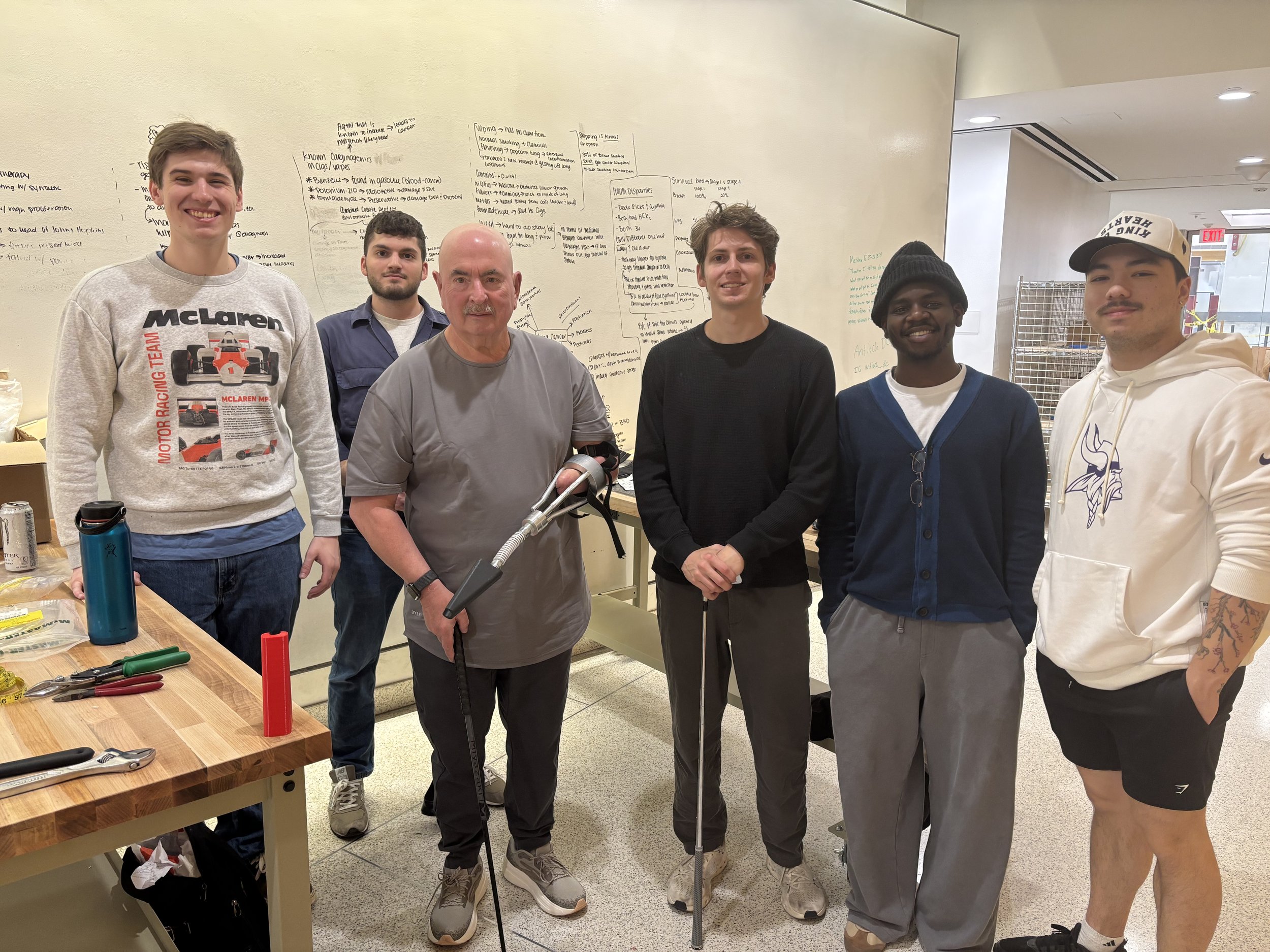
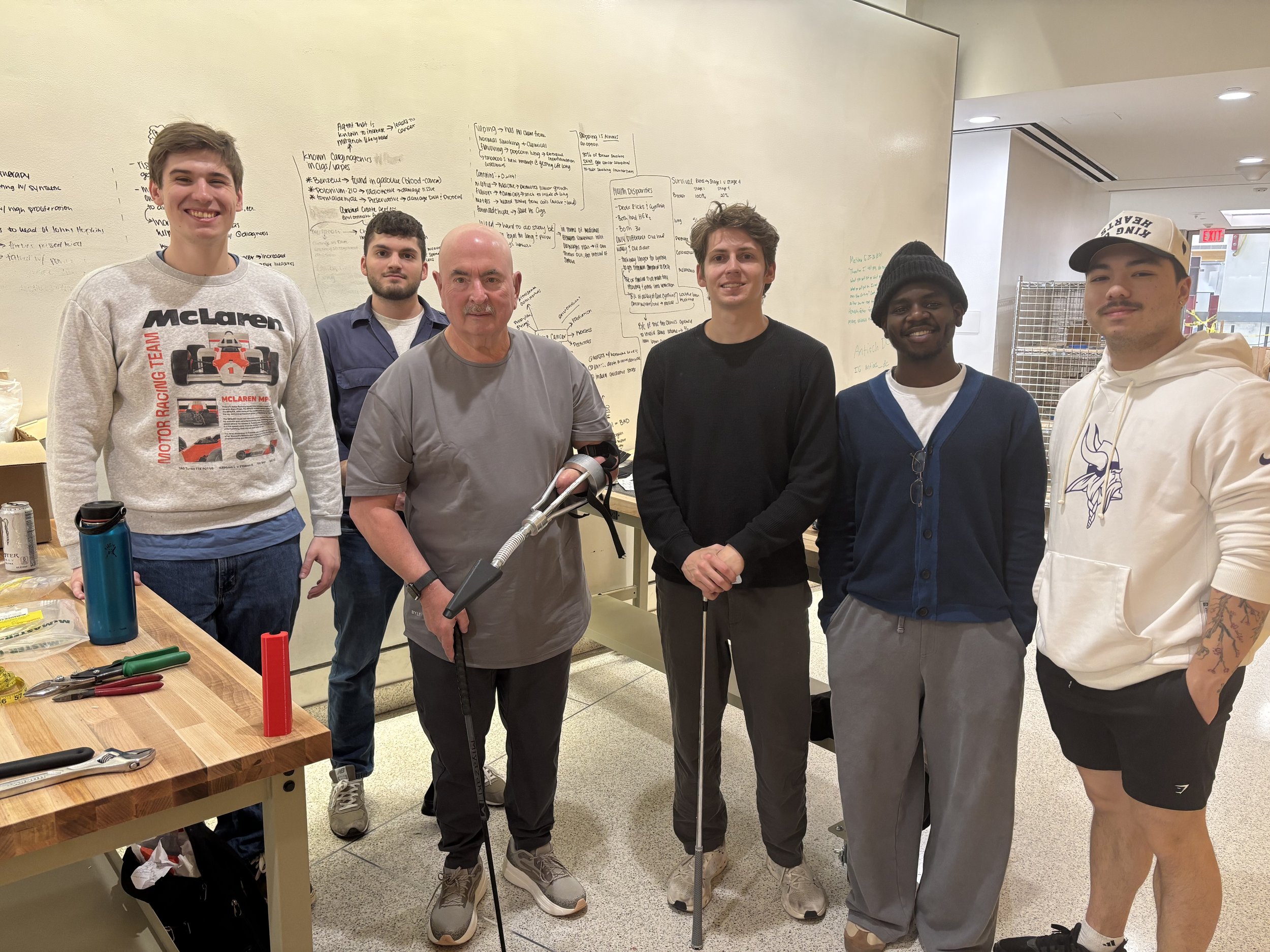
GWU Students & Col Paul Sturm
Engineering a Personalized Solution
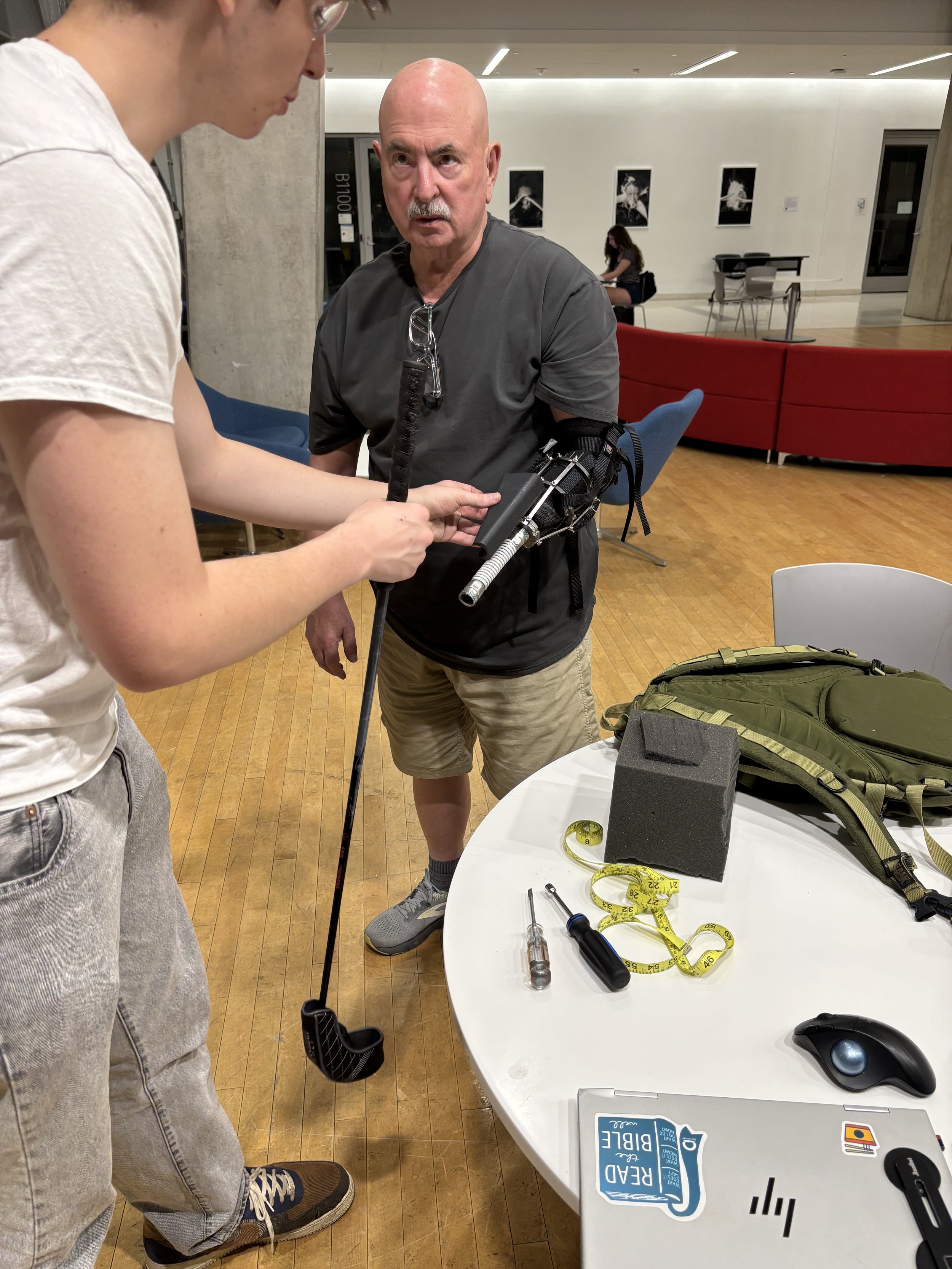
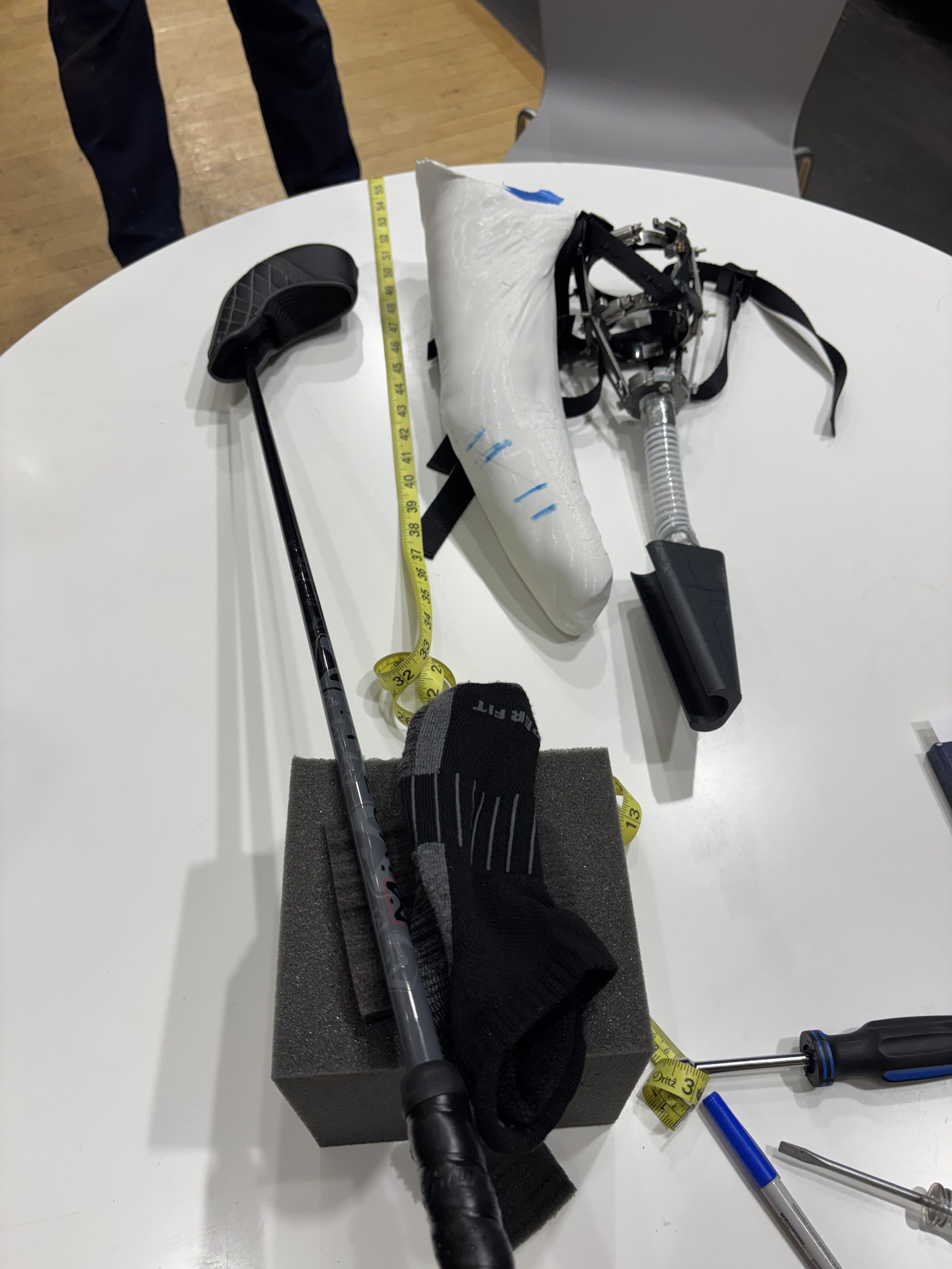
When Paul connected with Project S.E.R.V.E., he had very specific requirements that couldn’t be met by existing solutions:
It needed to be lightweight.
It couldn’t slip during a swing.
It had to function without a harness.
It needed to manage sweat during long, hot days.
And most importantly, it had to replicate the natural movement of the hand, wrist, and arm during a proper golf swing.
In addition to that, he also wanted to see how young senior student engineer minds collaborated to attack the problem and develop the solution. That’s where Mechanical Engineering student Aidan Kim and his team of fellow “Revvies” from George Washington University came in.
From the start, they knew this wouldn’t be a typical engineering project.
“The biggest thing that stood out was that Paul had a previous prosthetic that he did not like and did not use,” said Aidan. So the challenge wasn’t just to build something functional, but to build something Paul would actually want to use.
That reality is more common than many might expect. A recent study of 685 US veterans and non-veterans with upper-limb amputation found a 34.6% prosthesis non-use rate (237 participants), with 6.9% never using one; higher than the prior 6.8% veteran-only estimate. (Source:, Resnik L et al., 2023, PLoS One)
When Theory Meets Real Life
On paper, designing a prosthetic for Paul might seem straightforward but in reality, it was anything but. The team of students quickly ran into two major challenges:
The first was the arm attachment. Traditional prosthetics often rely on suction sockets, which can trap heat and sweat. “The design had to be breathable,” Aidan explained. “That was a major issue with what Paul had before.”
The second challenge was far more complex: replicating the movement of the wrist. “It sounds simple,” the student explained, “but you’re trying to recreate the function of eight bones and nearly thirty ligaments.”
At one point, the team believed they had a working design. They had spent significant time developing ways to replicate wrist movement., then came the reality check.
“When it came to manufacturing the prototype, we realized it wasn’t going to work. Not just in the way we thought, but entirely.”
It was back to square one.
Designing With, Not For
If there was one thing that defined this project, it was Paul’s involvement.
“Our goal was never to create an arbitrary prosthetic,” Aidan said. “Our goal was to create a prosthetic for Paul.”
That meant constant feedback and constant iteration. Anything Paul didn’t like was reworked. Priorities shifted as his input shaped the direction of the design.
What started as a focus on wrist movement gradually shifted toward improving the arm attachment based on real-world use and comfort.
This ‘veteran-student’ collaboration changed how the students approached the entire project.
“We learned that designing for real people requires a completely different mindset,” Aidan said. “Even if the design is technically perfect, if the person isn’t happy, the project fails.”
The Impact is Mutual
The collaborative approach to engineering is exactly what sets projects like this apart.
“Capstone projects involve designing and delivering a working system for a client,” said faculty advisor Steve Shooter who oversaw this project. “But this takes it to another level.”
The difference is proximity. Students aren’t simply working from assumptions. Instead, they are working directly with someone whose daily life could improve based on the outcome. “It becomes clear that the best result is not the best technical solution,” said Steve., “It is the best technical solution that the client will use.”
That lesson stood out for all the students involved. For Aidan personally, it’s already shaping what comes next in his career. “This project has opened up my job search to the medical device field,” he said. “It gave us experience in this sector and a real appreciation for it.”
At the same time, Paul is gaining something just as meaningful. More than the prosthetic itself, he’s been watching the process unfold. “More than my desire to swing a golf club better, I am excited by watching them through this process,” he said. “Their individual skills being brought forward, their desire for the solution, their development.”
Why This Work Matters
At its core, Project S.E.R.V.E. is about solving problems and connecting people. Students gain experience that goes far beyond the classroom, and they learn how to think differently, adapt, and design with real people in mind.
Veterans receive solutions that are built specifically for them. Not generic or theoretical, but grounded in their actual lives.
And somewhere in the middle, something powerful happens: better designs with a stronger sense of purpose. And in Paul’s case, a chance to step back onto the course with a swing that finally feels complete.